






Featured News


Posts List

Health

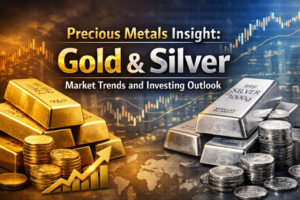
Precious Metals Insight: Gold & Silver Market Trends and Investing Outlook
📈 Current Gold & Silver Prices (as of today)
Based on live market data for January 22, 2026:
- Gold Spot Price: approx. $4,926.95 per ounce
- Silver Spot Price: approx. $96.57 per ounce
(Source: Money Metals Exchange live spot prices)
Gold and silver markets are drawing significant investor attention in early 2026 as prices remain at historically elevated levels, driven by economic uncertainty, geopolitical tensions, and strong industrial demand.
📊 Market Drivers: Why Prices Are High
Safe-Haven Demand & Geopolitical Risk
Gold’s role as a refuge in times of instability remains strong. Heightened geopolitical tensions and concerns about global trade and tariffs have helped push gold and silver prices toward record levels. For example, reports indicate precious metal premiums in India surged as traders anticipated higher import duties amid currency weakness and potential budget measures — driving stronger local demand and higher prices.
Investor Sentiment & Risk Appetite
According to recent financial news, both gold and silver prices have continued rising, supported by risk-averse investors looking to hedge against inflation and market volatility. Analysts note that even with pressures in traditional markets, investors are allocating capital toward precious metals as part of diversified portfolios.
Silver’s Industrial Tailwinds
Unlike gold — mostly a financial asset — silver enjoys dual demand: both investment and industrial. Its use in solar panels, electric vehicles, electronics, and clean-energy applications boosts long-term demand fundamentals. Supply constraints further tighten the market, as global production struggles to keep pace with rapidly expanding industrial use.
📉 Investing Dynamics: ETFs, Futures & Volatility
While spot prices are high, market instruments like gold and silver ETFs can behave differently. Recent reports show that precious metals ETFs have experienced price adjustments that are sometimes more volatile than physical metal pricing. Such dynamics highlight the importance of understanding differences between directly holding bullion versus investing in market-traded products.
Some advisors recommend cautious entry points, especially for silver, which has exhibited sharp short-term gains could lead to corrections. Technical indicators suggest that silver trading at multi-year high levels may face volatility, and investors are advised to weigh risk tolerance and investment horizon carefully.
📅 Macro Trends Shaping Precious Metals
Monetary Policy Expectations
Markets are pricing in potential interest rate cuts by central banks, which often support precious metal prices since lower yields on cash and bonds make non-yielding assets like gold and silver more attractive.
Safe-Haven vs. Growth Assets
Inflation concerns and slowdowns in economic growth continue driving hedging behavior. Precious metals have historically served as inflation hedges, making them appealing in uncertain macroeconomic environments.
🔍 Investor Takeaway
Gold and silver remain key components in diversified portfolios — offering both a hedge against economic turmoil and exposure to structural demand in industrial sectors. However, elevated price levels and recent volatility mean investors should consider their risk appetite, time horizon, and investment vehicle (physical metal, ETFs, or mining equities) before allocating capital.
Understanding not just price trends but also the underlying market drivers will be critical for making informed investment decisions in this dynamic precious metals landscape.


Economy

Global Economy at a Crossroads: Balancing Growth, Inflation, and Uncertainty
The global economy today stands at a critical juncture, shaped by a mix of recovery efforts, structural changes, and persistent uncertainty. After years of disruption caused by the pandemic, geopolitical tensions, and supply chain breakdowns, countries are striving to restore growth while managing inflation and protecting livelihoods. This delicate balancing act has made economic policymaking more complex than at any point in recent decades.
One of the central challenges facing economies worldwide is inflation. Rising prices for food, fuel, and essential goods have strained household budgets and reduced purchasing power. For many countries, inflation has been driven by a combination of supply constraints, high energy costs, and strong post-pandemic demand. Central banks have responded by tightening monetary policy, raising interest rates in an effort to cool spending and stabilize prices. While these measures are necessary to curb inflation, they also risk slowing economic growth and increasing borrowing costs for businesses and consumers.
Economic growth itself has become uneven across regions. Advanced economies have shown signs of stabilization, but growth remains modest. Developing and emerging economies, meanwhile, face additional hurdles such as currency volatility, high debt burdens, and limited fiscal space. Many of these nations depend heavily on imports for energy and food, making them particularly vulnerable to global price fluctuations. As a result, economic recovery has been slower and more fragile in parts of Africa, Latin America, and South Asia.
The labor market has also undergone significant transformation. While unemployment rates in some countries have fallen, labor participation has not fully recovered in others. Shifts toward remote work, automation, and digital platforms have changed the nature of employment. At the same time, many industries face labor shortages, especially in healthcare, construction, and technology. This mismatch between skills and job requirements highlights the urgent need for investment in education, training, and reskilling programs.
Another major factor shaping the modern economy is globalization’s evolving role. Trade remains a vital driver of growth, but global supply chains are being restructured to reduce dependence on single regions. Countries and companies are prioritizing resilience over efficiency, leading to strategies such as nearshoring and diversification of suppliers. While these changes may improve long-term stability, they can also increase costs in the short term, adding further pressure to inflation.
Technology and innovation continue to be powerful economic forces. Digital payments, artificial intelligence, and green technologies are creating new opportunities for productivity and growth. Investments in renewable energy and sustainable infrastructure are not only essential for addressing climate change but also for generating jobs and attracting long-term investment. Economies that successfully integrate technology with inclusive policies are more likely to remain competitive in the future.
Looking ahead, the path forward for the global economy will depend on cooperation, adaptability, and sound policy decisions. Governments must balance fiscal responsibility with targeted support for vulnerable populations. Central banks need to remain vigilant without stifling growth. Above all, long-term economic stability will require addressing inequality, investing in human capital, and fostering sustainable development. In a world of constant change, resilience and inclusivity may prove to be the most valuable economic assets.



Latest News

IS AWS Really Falling Behind? The Truth About the Cloud Battle with Azure and Google Cloud
Introduction: The Cloud War Narrative Amazon Web Services (AWS) has long been the dominant force in cloud computing, setting the standard for scalability, reliability, and innovation. However, recent headlines and…
Precious Metals Insight: Gold & Silver Market Trends and Investing Outlook
📈 Current Gold & Silver Prices (as of today) Based on live market data for January 22, 2026: Gold and silver markets are drawing significant investor attention in early 2026…

NEW FAB WOMENS WORLD
Where Tradition Meets Elegance Discover a beautiful collection of Indian women’s clothing crafted to bring out your grace and confidence. At NEW FAB WOMENS WORLD, we offer a wide range…

How Small Businesses Are Adapting to a Rapidly Changing Global Market
In today’s fast-paced economic environment, small businesses are facing unprecedented challenges—and opportunities. From technological disruption and changing consumer behavior to global economic uncertainty, the way businesses operate is undergoing a…

Artificial Intelligence: Transforming the Digital World and Human Potential
Artificial Intelligence (AI) has rapidly evolved from a futuristic concept into a powerful force shaping nearly every aspect of modern life. From smartphones and smart homes to healthcare, finance, and…